

2026 IT Sourcing Study – Nordics
The 2026 Nordic IT Sourcing Study provides a comprehensive assessment of IT service and cloud platform providers across Denmark, Finland, Norway, and Sweden. This year’s study evaluates over 1,000 unique IT sourcing relationships and more than 1,600 cloud platform relationships, based on feedback from over 450 of the region’s largest IT-spending organisations.

IT sourcing strategies across the Nordics remain broadly stable.
31% of organisations plan to increase spending on external providers in the next two years, up from 28% in 2025, while 38% expect no change. At the same time, 20% plan to reduce spending, and 11% are unsure.
Outsourcing growth led by Sweden and Denmark.
Sweden (37%) and Denmark (33%) show the strongest momentum toward increased outsourcing, while Norway is more cautious with only 19% planning increases. Finland shows the strongest insourcing trend, with 29% planning to reduce spending on external providers.
Flexibility, cost efficiency, and access to technology drive outsourcing.
The ability to scale resources up or down is the leading driver for increased use of external providers (56%). Cost reduction (53%) and the ability to focus on core business activities (52%) are also major factors. Access to emerging technologies is cited by 44% of organisations, highlighting the growing role of providers in supporting digital transformation.
Top 3 Drivers for Outsourcing More
Drivers for outsourcing vary across Nordic countries.
Denmark places the strongest emphasis on cost reduction and scalability (both 71%), while Finland prioritises strategic focus and access to emerging technologies (both 63%). Norway stands out for its innovation-driven approach, with 53% citing access to business innovation, while Sweden highlights scalability (62%) as a key driver.
Knowledge retention and cost efficiency drive insourcing decisions.
Organisations planning to reduce reliance on external providers primarily cite the need to retain critical knowledge internally (60%). Cost efficiency is another key driver, with 51% believing insourcing can be financially more attractive than outsourcing.
Drivers for Insourcing
Nearshore and offshore delivery expected to grow as onshore declines.
Thirty percent of organisations plan to increase nearshore delivery and 27% offshore, while 26% expect to reduce onshore delivery, reflecting efforts to optimise costs and access talent while maintaining proximity. Sweden and Denmark show the strongest shift toward global delivery, while Norway remains more cautious about offshore expansion. Across industries, manufacturing and financial services lead offshore growth, while the public sector favours onshore delivery, likely due to regulatory and sovereignty considerations.
AI and GenAI adoption are nearly universal, but few organisations see a significant impact on operations.
Widely available tools such as ChatGPT and Microsoft Copilot are used by 36% of organisations, while 17% experiment with internally developed AI solutions. The effect on business remains limited: 10% now report a significant impact on business operations from their own AI initiatives (up from 5% last year), and a truly transformative impact remains rare at just 2%.
Business Impact of AI Adoption
Captive IT delivery centres remain selective.
Most Nordic organisations (52%) do not operate a captive IT delivery centre. Among those that do, nearshore captives are slightly more common: 15% operate a nearshore-only captive, 10% an offshore-only model, and 13% a hybrid setup. Key benefits cited by clients include stronger knowledge retention (54%), cost reduction (49%), and lower staff turnover/improved quality (both at 42%).
Benefits of Captive Adoption
Sovereign IT is influencing strategies, but disruption remains limited.
Nearly half of organisations report some impact on their IT strategy, with 26% making small adjustments and 23% reporting medium changes. Only 6% report major impacts, such as cloud exits or platform changes, while 27% remain unsure, indicating that many organisations are still evaluating the implications of sovereignty requirements.
Impact of Sovereign IT
Hyperscaler usage remains largely stable.
Despite sovereignty concerns, most organisations expect their use of hyperscalers to remain stable or increase. Twenty-six percent plan to increase usage, while 36% expect no change, indicating continued reliance on platforms such as AWS, Microsoft Azure, and Google Cloud. Only 16% anticipate reductions, typically small adjustments rather than major cloud exits. Denmark stands out, with 27% planning small-to-medium reductions, suggesting a stronger impact of sovereignty considerations.
Hyperscaler Usage
26%
Increase Usage
36%
No Change
Client satisfaction continues to improve.
Out of 1,012 evaluated IT sourcing relationships, 71% are rated satisfied or very satisfied, up from 67% last year, while dissatisfaction has fallen to 7%. Denmark records the highest share of very satisfied relationships (28%), while Finland shows more moderate levels of satisfaction (10%).
Percentage of Very Satisfied IT Sourcing Relationships
28%
Denmark
10%
Finland
Competition intensifies among service providers.
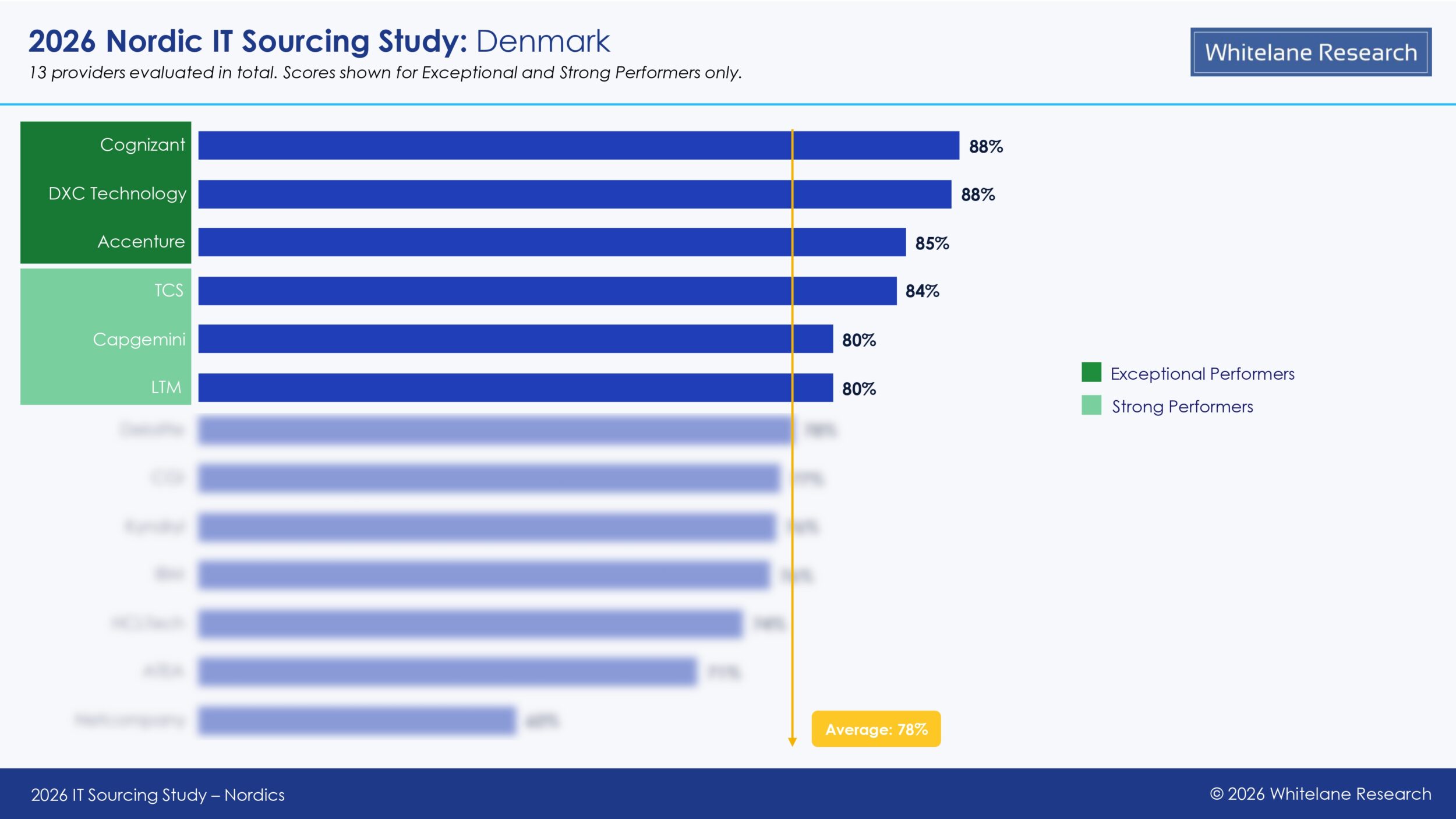
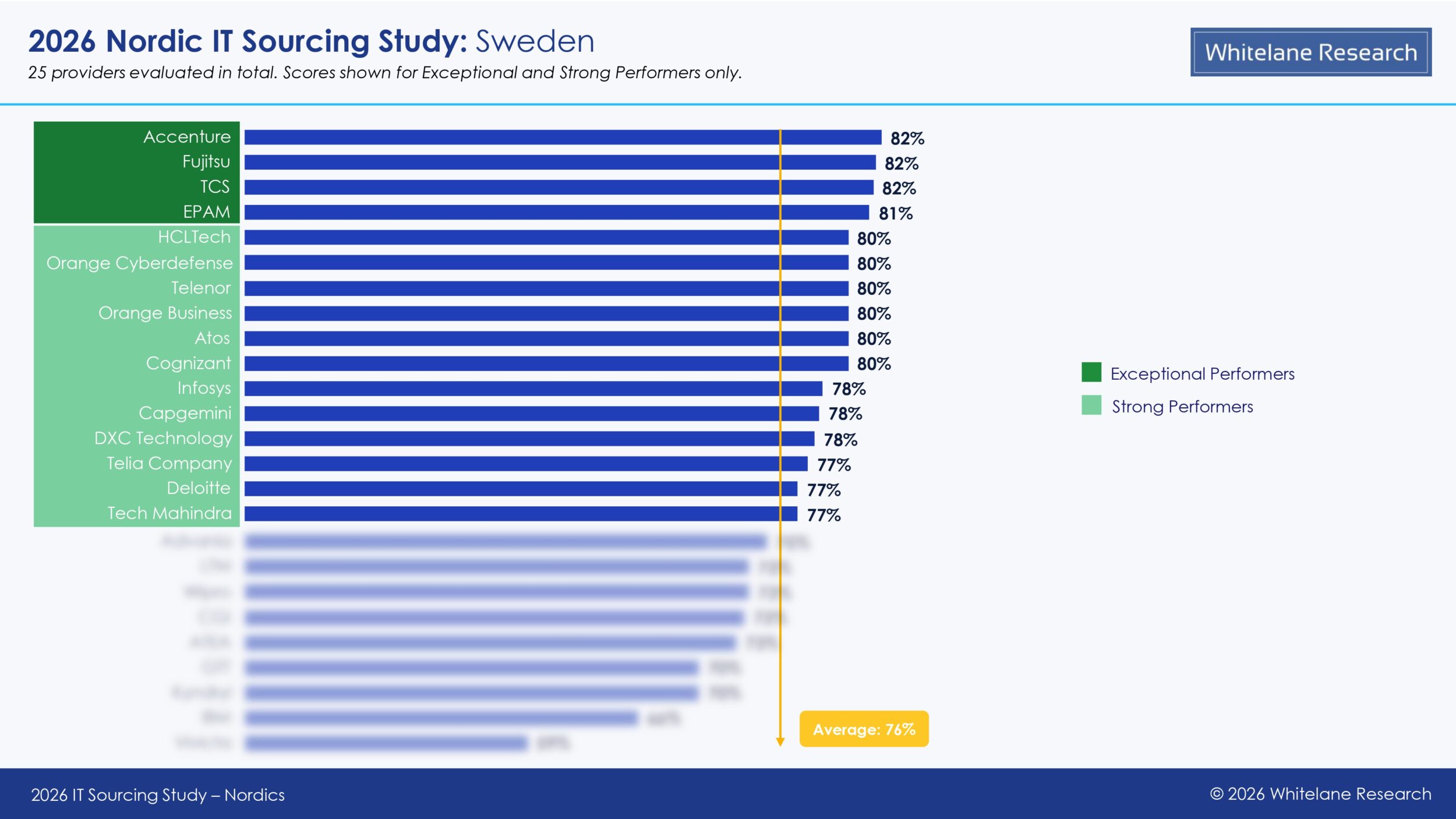
In the general satisfaction ranking, Accenture, TCS, EPAM, and Cognizant share first place with 82%, closely followed by DXC Technology and Infosys at 81%, with only one percentage point separating the top six providers. Overall satisfaction has increased by two percentage points to 75%, the highest level to date.
2026 Average Satisfaction
75%




Clients expect more strategic value from providers.
The most frequently cited provider weakness is a lack of challenge (41%), followed by insufficient business knowledge (28%) and lack of partnership (27%). These findings indicate that many providers are still perceived as transactional suppliers rather than strategic partners.
Top 3 Service Provider Weaknesses
AWS and Microsoft Office 365 lead the cloud platform rankings.
AWS tops the infrastructure cloud platforms ranking with 76%, closely followed by Google Cloud Platform (75%) and Microsoft Azure (74%). In the software cloud category, Microsoft Office 365 ranks first with 78%, ahead of Google Workspace (77%). Overall satisfaction with both infrastructure and software cloud platforms has improved, increasing by two percentage points to 70% and 71%, respectively.
IaaS/PaaS
SaaS
2026 Final Report – Nordics
Whitelane’s final report offers key insights into IT sourcing and governance trends, featuring rankings of IT service providers across five IT service towers and four key performance indicators (KPIs). It also includes rankings of the leading cloud platform providers for both IaaS/PaaS and SaaS. For more information, contact info(@)whitelane.com
